 Delta Plumbers
Basement flooding in Mississauga doesn’t only happen during “once-in-a-century” storms. Intense summer downpours, rapid spring thaws, and sewer surcharging can all send wastewater the wrong way—up through floor drains, tubs, and basement toilets. A properly selected and maintained backwater valve is one of the most cost-effective lines of defence a homeowner can install. This guide breaks down budget-friendly backwater valve options, explains how they work, outlines what’s code-compliant in Ontario, provides realistic costs, and offers the smartest ways to stretch your dollar without sacrificing protection.
Picture Source – Delta Plumbers
Why Mississauga Basements Flood, and How Backwater Valves Help
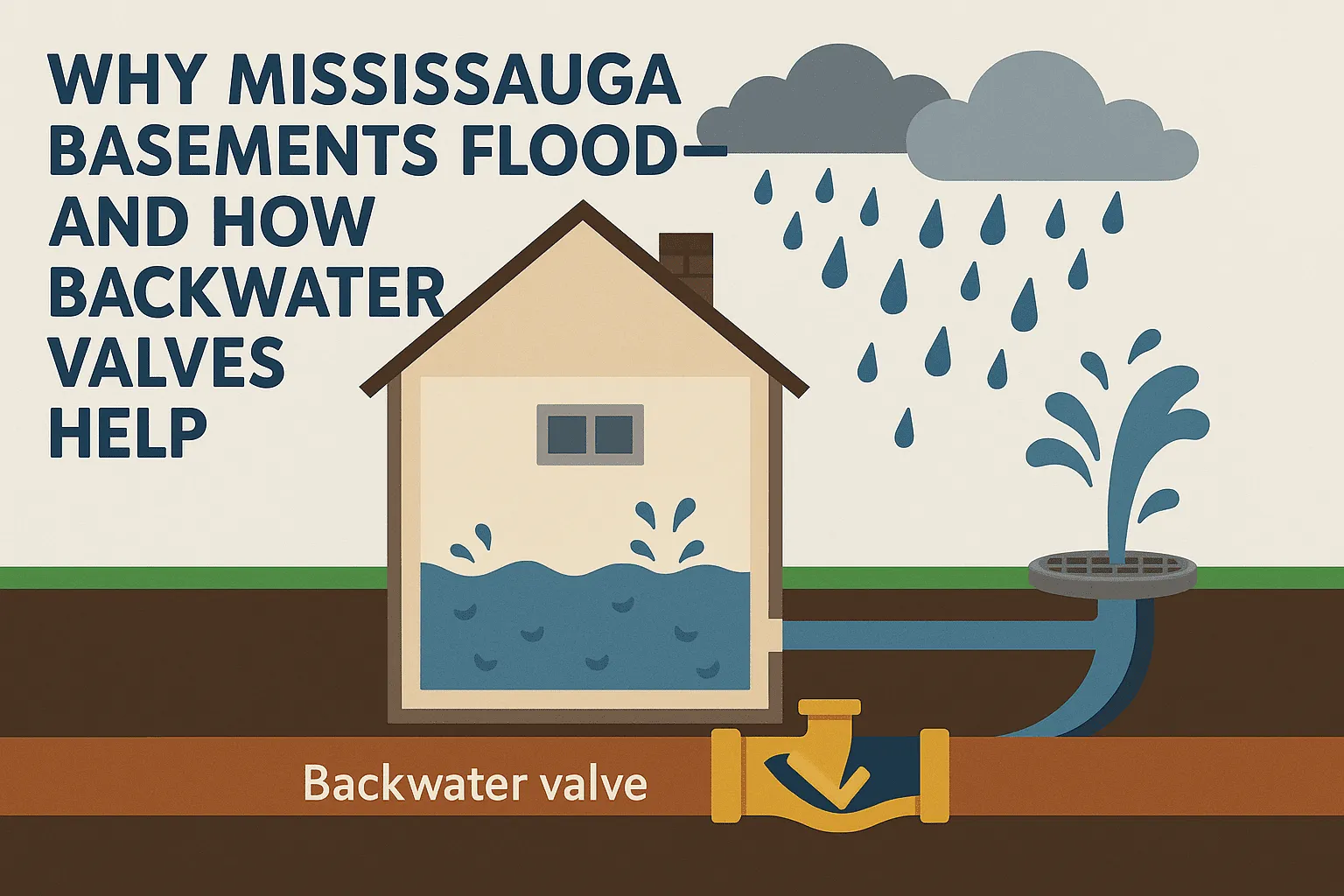
What’s actually happening during a sewer backup? In heavy rain, the municipal sanitary main can become surcharged. When pressure in the main exceeds the pressure in your home’s sanitary line, wastewater seeks the nearest exit—often your lowest fixture (floor drain, shower, or toilet). Mississauga’s mix of older neighbourhoods and newer infill, clay or cast-iron laterals in some areas, plus maturing root systems, means even a partial restriction can worsen a surge.
A backwater valve (BWV) is a one-way gate installed on the sanitary building drain or main sanitary branch. Under normal conditions, it remains open, allowing waste to exit your home. When sewage tries to push back from the street, the valve seals, blocking reverse flow and protecting your finished space, furnace room, and storage.
Why it’s budget-smart: Compared to one cleanup (demo, drying, mould remediation, flooring), a BWV is inexpensive insurance. Many insurers in the GTA now ask about backwater valves on basement-finished homes; some offer premium reductions after installation. For flood-prone blocks, pairing a BWV with downspout extensions and a healthy sump system gives the best cost-to-protection ratio.
Also Read: Sewer Inspection Grants in Niagara Falls

Picture Source – Delta Plumbers
Ontario Code & Placement Basics (So You Don’t Waste Money)
Spending wisely means doing it once, correctly. In Ontario, the Ontario Building Code (OBC) requires that sanitary backwater valves, when used for fixture protection, be full-port type and readily accessible for inspection and maintenance. A budget install that hides the valve under concrete without an access box will cost more later.
Where it goes (typical budget-friendly layout):
- Mainline full-port BWV on the sanitary building drain downstream of all fixtures you want to protect and upstream of the foundation wall exit.
- Accessible valve box with removable cover flush to the slab.
- If your basement bathroom is on a branch that drops lower than the rest of the floor, the valve may need to sit upstream of that junction to protect it, too.
What a backwater valve does NOT do:
- It does not protect against groundwater rising under the slab (that’s what perimeter drains + sump pump Mississauga setups are for).
- It does not replace a backwater valve on the storm service if your home has a separate storm line that can also surcharge (common in certain subdivisions).
Budget note: Ask your plumber, Mississauga, to camera the line first. A $200–$400 diagnostic can save thousands by confirming the right placement, verifying slope, and spotting hidden issues (roots, offsets) before you open the floor.
Also Read: Protecting Your Pickering Home from Spring Runoff: Sump Pump Upgrades That Work
Picture Source – Delta Plumbers
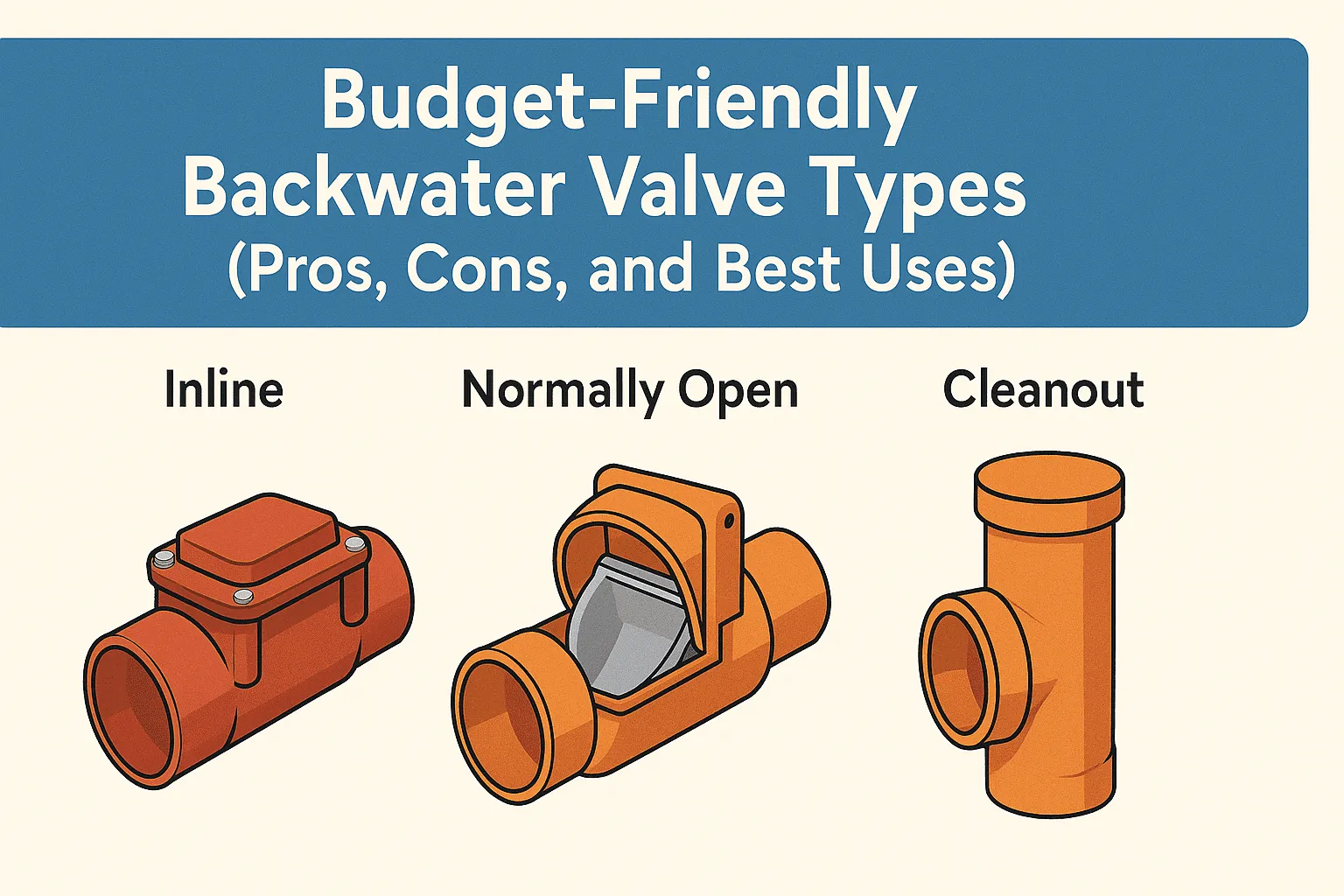
Budget-Friendly Backwater Valve Types (Pros, Cons, and Best Uses)
Not all valves are equal. Here’s a practical buyer’s guide that balances cost, code, and performance.
A) Full-Port Mainline Backwater Valve (Normally Open)
- What it is: A clear-lid, full-bore body with a hinged gate that floats up and seals during backflow; remains open in normal use to minimize clogging.
- Why it’s budget-smart: Widely available, code-friendly, simple to service (you can see debris through the lid), and protects the entire basement on one device.
- Best for: Most Mississauga homes wanting whole-basement protection with minimal flow restriction.
- Watch-outs: Needs a straight run and proper grade. Must be kept clean to seal reliably.
B) Branch Line (Fixture-Specific) Backwater Valve
- What it is: Smaller valves installed on individual branches (e.g., a basement bathroom group).
- Budget angle: Lower per-valve part cost, but multiple units may exceed one mainline valve’s price after labour.
- Best for: Retrofits where mainline access is tough or you only need to protect one zone.
- Watch-outs: Each valve adds maintenance points; if you miss one line, you can still flood.
C) Normally Closed Backwater Valve (Actuated/Gate Style)
- What it is: Closes by default and opens only on demand or by float/actuation.
- Why it’s not “budget”: Higher cost and more complexity; great for special scenarios (commercial, high-risk), overkill for typical homes.
- Best for: Unique use-cases where proactive closure is required.
D) Floor-Drain Check Devices (Temporary/Stopper-Type)
- What it is: Rubber or mechanical stoppers to block a floor drain in surge.
- Budget reality: Ultra-cheap but not code for sanitary line protection, unreliable, and easy to forget. Consider only as an emergency stopgap—not your primary defence.
Bottom line: For most homeowners balancing performance with cost, the full-port mainline BWV offers the best long-term value.
Also Read: Common Plumbing Challenges in Older Hamilton Homes (1920–1950)—And How We Fix Them

Picture Source – Delta Plumbers
Costs You Can Actually Expect (And Where to Save)
Parts:
- Full-port mainline backwater valve body: typically $120–$350 depending on brand and size.
- Valve box/clear access lid kit: $60–$180.
- Misc. couplings, pipe, primer/cement: $40–$120.
Labour & concrete work:
- Sawcutting slab, excavation, install, concrete patch: $900–$2,000 for straightforward access.
- Add camera inspection & permits: $200–$600 combined (varies by scope).
Typical all-in range: $1,300–$2,900 for a standard backwater valve installation in Mississauga when the main is accessible and in good condition. Complex layouts, deep drains, or lateral repairs add cost.
Where to save without cutting safety:
- Combine work: If you already plan to add a sump pump or fix a section of pipe, doing it in one visit reduces duplicate saw-cutting and concrete patching.
- Choose full-port plastic bodies with clear lids over premium metal bodies for residential lines—easier maintenance, lower price, fully code-compliant.
- Keep the run straight: The more fittings and jogs, the more labour. A straight install is faster and cheaper.
Where NOT to cheap out:
- No access = no savings. An inaccessible valve will fail when you need it most.
- Skip chemical shortcuts. If a camera shows roots or a belly, solve those first; a valve alone won’t cure chronic blockages.
- Permits/inspections: Stay compliant to keep insurance valid and resale clean.
Also Read: Top 5 Frequently Asked Plumbing Questions from Ajax Residents

Picture Source – Delta Plumbers
Step-By-Step: Budget-Smart Installation That Lasts
A clear process prevents surprises and scope creep.
Assessment & Camera Inspection
- Verify pipe size, slope, and location of tees/branches.
- Confirm ideal valve placement to protect all basement fixtures.
- Check for roots, cracks, or sagging that could undermine the install.
Mark-Out & Sawcut
- Map utilities; mark a compact, straight trench to minimize concrete restoration.
Excavate & Prep
- Expose the sanitary line. Clean and dry the cut area.
- Dry-fit the full-port backwater valve and access box to ensure the lid sits flush with finished slab height.
Install & Solvent Weld
- Use shielded couplings where needed, support pipe to maintain slope.
- Orient the valve arrow with normal flow; ensure flap movement is unobstructed.
Inspection (as required)
- City/building inspection to confirm code compliance and access.
Concrete Patch & Finish
- Backfill with compacted gravel, patch the concrete flush, and leave the access lid cleanly exposed.
Commissioning
- Water test under normal flow and simulate backflow to verify the seal.
- Demonstrate the maintenance routine to the homeowner.
Budget tip: Ask your plumber in Mississauga for a before/after camera video. It’s cheap documentation that proves placement and protects you during resale or insurance conversations.
Also Read: Green Plumbing in Toronto: Eco-Friendly Upgrades That Save Water and Money

Picture Source – Delta Plumbers
Maintenance: The $0 – $20 Habit That Saves Thousands
A backwater valve only works if it’s clean and moving freely. Dirt, wipes, and fat-oil-grease (FOG) can keep the flapper from sealing.
Quarterly (or before major rain):
- Pop the clear lid (or remove the access cover).
- Visually check for debris; wipe the gate and seat.
- Pour a few buckets of water upstairs and watch the flap: it should stay fully open in forward flow.
- Simulate backflow by gently lifting the gate to ensure a full seal and smooth return.
After any backup or drain cleaning:
- Re-inspect the valve; auger debris can wedge under the flap.
- Replace worn gaskets promptly—budget parts that prevent expensive floods.
House rules that extend valve life:
- No wipes (even “flushable”).
- Scrape grease into the trash, not the sink.
- Keep a simple enzyme drain maintenance routine to reduce biofilm (consult your plumber for compatible products).
Emergency plumber Mississauga tip: If you smell sewage or hear gurgling during storms, stop using water, check the valve immediately, and call for help before pressure rises.
Also Read: Top 7 Plumbing Problems in Vaughan Homes (and When to DIY vs. When to Call Delta Plumbers)

Picture Source – Delta Plumbers
Stack Your Defences: Budget Upgrades That Multiply Protection
A backwater valve is critical for sewer backup—but other flood paths still exist. Layering low-cost upgrades keeps you in budget while closing the most common gaps.
A) Downspout Extensions & Grading (Often <$100 per downspout)
- Extensions that carry roof water 2–3 m from the foundation cut basement seepage dramatically.
- Regrade low spots so water runs away from the wall.
B) Sump Pump + Battery Backup
- Sump pump Mississauga installations remove groundwater before it reaches the slab.
- A basic battery backup keeps pumping through power outages that coincide with storms—common in summer squalls.
C) Floor Drain Check on Storm-Only Lines
- If your floor drain ties to storm (varies by subdivision), a mechanical floor drain check can help, but don’t rely on it for sanitary events. Always prioritize a mainline backwater valve on sanitary.
D) Backwater Valve on Storm Service (If Applicable)
- Some homes with separate storm laterals benefit from storm BWVs too. Ask for a camera to confirm your site conditions.
E) Smart Leak/Water Sensors
- Budget Wi-Fi pucks near the valve pit, sump, and hot water tank alert you early. Early alarms often decide whether you mop or gut a basement.
F) Annual “Flood Readiness” Tune-Up
- A quick pro visit to clean the valve, test the sump, snake a known bottleneck, and verify downspouts can be the best sub-$300 you spend all year.
Quick FAQ for Mississauga Homeowners
1. Will a backwater valve stop every kind of basement flooding?
No. It stops sewer backup in Mississauga events (reverse sanitary flow). It won’t stop groundwater rising under the slab—that’s a sump pump job—or surface water pouring through window wells (fix grading/drainage).
2. Do I need permits for backwater valve installation in Mississauga?
Most sanitary BWV installs require permits/inspection. Staying compliant protects insurance and resale. Ask your plumber, Mississauga, to handle the paperwork.
3. How often should I service it?
Check quarterly, before big storms, and after any drain cleaning. Plan a yearly professional service.
4. What size is typical?
Most homes use 3″ or 4″ full-port valves to match the building drain. Your plumber will confirm by camera.
5. Is a cheaper floor drain stopper enough?
No. It’s not code for sanitary protection and fails under real surges. Consider it only as a temporary measure while you schedule a proper valve.
Sample Budget Scenarios (So You Can Plan)
A: Finished basement, straight run, easy access
- Camera, mainline full-port BWV, access box, patch: $1,600–$2,200
- Annual service: $120–$250
- Add two downspout extensions: $80–$200
Result: High protection for common sanitary surges at modest spend.
B: Older home, minor root intrusion, shallow main
- Camera, localized root cutting, BWV install: $1,900–$2,600
- Enzyme maintenance & “no-wipes” policy: negligible cost
Result: Address cause + install protection; still budget-minded.
C: Frequent outages during storms
- BWV + sump battery backup + leak sensors: $2,700–$3,600
Result: Sewer backup protection + groundwater control during power cuts.
When to DIY—and When to Call a Pro
DIY-friendly:
- Downspout extensions, re-caulking exterior penetrations
- Monitoring the clear-lid valve and removing light debris
- Replacing access-box gaskets and lids
Professional only:
- Cutting slab, tying into sanitary drain, setting slope fall
- Any permit/inspection work and code compliance
- Complex branches, deep drains, or lateral defects
- Pairing sanitary and storm strategies correctly (camera-verified)
For urgent symptoms—gurgling, slow drains during storms, sewage odours—call an emergency plumber Mississauga before the next rainfall.
Conclusion –
A full-port mainline backwater valve—installed with proper access, confirmed by camera, and maintained quarterly—delivers the best cost-to-protection ratio against sewer backup Mississauga events. Stack it with inexpensive drainage fixes, a reliable sump pump where needed, and basic monitoring, and you’ll outperform far pricier, piecemeal “fixes.”
If your home has finished space below grade, tools or inventory you can’t afford to lose, or a history of surcharging on your block, putting a backwater valve at the top of your basement waterproofing Mississauga plan is the budget move that actually works.
For code-compliant backwater valve installation in Mississauga, camera diagnostics, and same-day help before the next storm, contact your local plumber in Mississauga.
Plumbing Services Across Ontario You Can Trust 🚚💧
Delta Plumbers proudly brings reliable plumbing solutions to homeowners throughout Ontario. Whether you need a quick repair, a full system replacement, or emergency service, our skilled plumbers are here for you. We’re currently serving:
Our coverage also includes Toronto, Kingston, Oakville, Scarborough, Aurora, Burlington, Markham, Hamilton, Kitchener, and many other Ontario communities.
Wherever you’re located, Delta Plumbers delivers prompt, professional plumbing services you can depend on.